Imperial Bedroom Lyrics Chords Best Again Dressed
Bruce Thomas (Elvis Costello & The Attractions) RADIO INTERVIEW
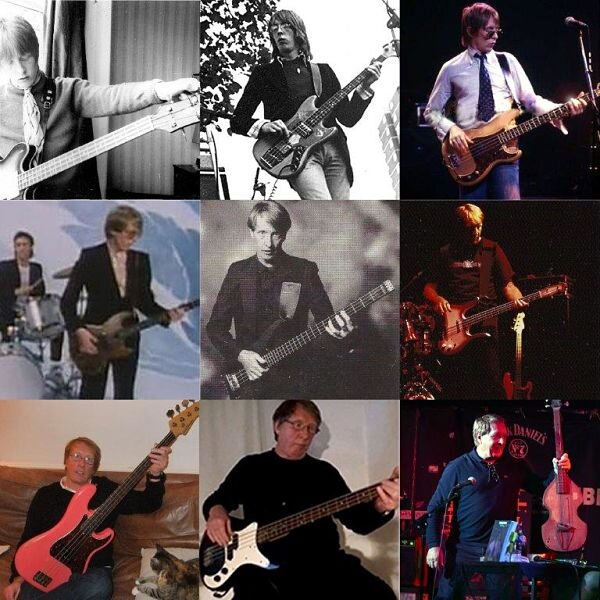
KNOW YOUR BASS Player / THE BASS GUITAR Channel RADIO SHOW: A Chat with Bruce Thomas
In February 2021, Rock and Curl Hall of Fame bassist Bruce Thomas (Elvis Costello & The Attractions, Suzanne Vega, Paul McCartney's Rockestra ) was a guest on THE BASS GUITAR CHANNEL RADIO SHOW, hosted by David C. Gross along with Know Your Bass Player "honcho" Tom Semioli on Cygnus Radio. Here are edited highlights from our conversation: note that due to copyright restrictions, we are not able to include the songs Bruce plays on and/or discusses, even so for those of you keeping score at home, they include: Fleetwood Mac "Globe Keeps On Turning," Paul McCartney "Rockestra Theme," Elvis Costello & The Attractions: "Everyday I Write the Volume," "Political party Girl," "I Don't Want to Become To Chelsea"; The Beatles "Hello Goodbye," Everly Brothers "Price of Honey," Rolling Stones "Under My Thumb," Level 42 "Chinese Way," Richard Hell "You Gotta Lose," Suzanne Vega "Every bit Girls Go," John Wesley Harding "An Audience With You," Quiver "Killer Man," Nick Lowe "American Squirm." Interviewers David C. Gross, Tom Semioli. Editor: Marker Polott
Editor's Note By Thomas Semioli
To rock bass players who came of historic period in the late 1970s and early on 1980s (myself included) – he was the main Attraction!
He is amid the outstanding bass players of Britain's golden era of vocalist-songwriter "pub rockers" – which somehow got categorized as "punk." Alike to Norman Watt-Roy (Ian Dury & The Blockheads), Graham Maby (Joe Jackson Band) and Andrew Bodner (Graham Parker & The Rumour) – Bruce Thomas exuded a forceful melodic style and sound that fabricated him instantly recognizable.
Declan McManus (must've) hit the ceiling when Bass Role player magazine dared its readers to render a Costello tune without Thomas' signature passages only to notice that the songs weren't that "brilliant" in the first place. This seventeen year-old reader tried information technology back in '78, whittling Bruce's motifs to typical root, tertiary, 5th pocket patterns. Bass Actor was right!
With a yen for American rhythm and blues, soul, and British rock 'n' roll – Mr. Thomas absorbed the work of such elite bassists every bit James Jamerson, Sir Paul, Bill Wyman, Paul Samwell-Smith and Jack Bruce and forged it upon the "new wave." As I was witness, his presence on stage overshadowed his bandleader – a rarity for bass players.
When KYBP travelled to London in Nov 2019, we had scheduled an on-camera interview with Bruce at Terminal Studios in Bermondsey. Heck, I would make the trip beyond the Atlantic on Virgin coach merely to converse with Thomas. Unfortunately Bruce was nether the weather and we had to postpone until April 2020. However the COVID-nineteen pandemic cancelled those plans until farther notice…
Never say dice at KYBP, dig Joe Gagliardo's Bruce Thomas profile based (pun intended) from a June 2022 chat!
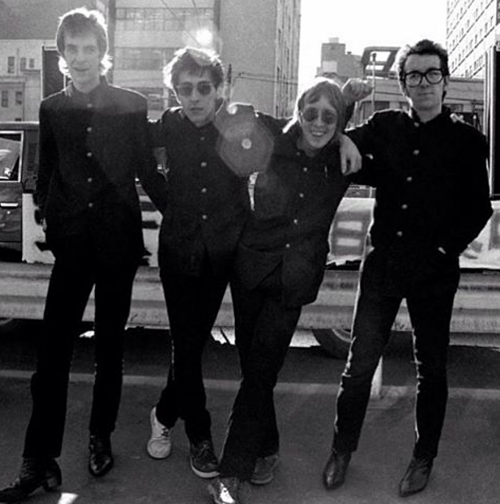
Courtesy of Rhino Records
By Joe Gagliardo
Bruce Thomas' tough melodic lines as anchor of Elvis Costello & The Attractions accept inspired numerous players. Revered by his peers, a Beatle, and stone fans worldwide, Bruce'due south outstanding career on phase and in the studio, before, during and later The Attractions, is the stuff of fable.
What did Bruce mean to Elvis' Attractions? Bass Player magazine noted that "his bass lines consistently [bring] Costello'south songs to a new level with tasty, melodic parts that fit perfectly with the chords, melody and lyrics."
Referencing "Everyday I Write the Book," BP proclaimed that Thomas' bass lines were "full of playful syncopations, chords, experience changes and slides, [and that] his part masterfully straddles the fine line between careful support and break-from-the-pack inventiveness."
Bruce had no formal music preparation. Like many of united states, as a kid he pressed his ear to the radio under the bedsheets at night to hear the bass. Radio Grand duchy of luxembourg was his pop music station of choice – among the shows he tuned into featured a broadcast from The Cavern in Liverpool, affording him the opportunity to hear bands that emerged on the heels of the Beatles' success.
The Shadows were the offset ring Bruce saw perform live, and his attention was immediately drawn to legendary bassist Jet Harris and his signature crimson Fender Precision bass, which matched Hank Marvin's red Fender Stratocaster guitar. The song "36-24-36" – a bass driven instrumental – was among Bruce's favorite songs. Johnny Gustafson, the bassist with The Merseybeats, also defenseless his attending. Bruce describes the four cornerstones of bass equally Paul McCartney, John Entwistle, Duck Dunn, and James Jamerson.
Bruce never desired to be a guitarist. Beingness attracted (pun intended) to the instrument by the music he was hearing, he tried to construct a bass using telephone parts equally a pickup with a Spanish guitar bridge. It had an eleven-note octave on it because, somewhere forth the fashion Thomas lost count!
Though Thomas had an affinity for bass, his gig equally a harmonica player led to his first gig as a bassist. Inspired by the function the harmonica played in the music of the Rolling Stones, The Yardbirds, and the British r&b and dejection groups, Bruce was working the rima oris harp in a local ring, The Tremors. Ane night the bass player didn't testify, and without even a cursory rehearsal – the absent bassist'south blonde Epiphone Rivoli was handed to Bruce and he had to wing information technology. From that point on, he became a bassist – practicing for hours on end every day along with records, radio, and the television receiver.
While toiling for paper company in the mid-60s, he and two of his co-workers, Paul Rodgers and Mick Moody would often discuss music and artists such as the Paul Butterfield Blues Band. Equally their friendship developed, Bruce was invited to join their band, The Roadrunners, which was a rhythm and blues, Motown soul ensemble.
Paul Rodgers had been The Roadrunners' bassist- however he wanted to concentrate on singing and fronting the band. Hence Bruce took over, using Paul'south Vox bass, that is – until the neck perpetually bowed and the action got higher and college to the point where Bruce was pulling the neck dorsum in society to hitting the right notes. The use of that instrument came to an abrupt end when the neck snapped.
The Roadrunners moved to London to seek fame and fortune, but bankrupt up rapidly thereafter. Fate was kind to Paul Rodgers who went on to play with Paul Kossoff, Andy Fraser, and Simon Kirke in Costless, and later on, with Mick Ralphs and Boz Burrell Bad Visitor, and Queen + Paul Rodgers, and is rightly considered i of the greatest rock vocalists of all time.
Mick Moody found success every bit well, joining Whitesnake, a band led by David Coverdale that would proceed to platinum sales and filling arenas worldwide. Bruce auditioned for a pre-Fleetwood Mac Peter Green and Jeremy Spencer commonage. Though that experience culminated in a "peachy two-60 minutes jam," Peter politely informed Bruce "you've got all the notes…but y'all don't quite put them together." According to Bruce information technology was too early on in his playing career. Withal that incident was more than than made up for years later when he and Peter Green jammed at the Marquee Social club, and later played together on Peter Bardens' solo album, The Answer.
Bruce had far better luck with keyboard actor Peter Bardens, who formed the band Village – an organ, bass and drums trio. Following that audition, Bardens told Bruce "y'all've got the notes! And you're the only actor I've heard all week who tin can actually swing!" That was a heavy compliment, considering the line up in Bardens' previous ring had included Mick Fleetwood, Rod Stewart and Peter Green!
Village worked upwards a jazzy rhythm and dejection repertoire featuring cloth by the likes of Jimmy Smith and Miles Davis. The band earned a residency at the prestigious Marquee Lodge, where back up acts for Village included Elton John and Brinsley Schwarz.
Each week, Village invited special guests to perform with them, giving Bruce the opportunity to hone his skills working along London's all-time musicians. Amidst those guests once once more was Peter Greenish which Bruce recalls every bit a highlight of his career. It wasn't just talent or technique according to Thomas, "yes, he had taste and fire, but his playing came from deep inside of his soul … it is rare to hear someone play every bit deep as Peter Green."
By 1971 Bruce was playing with renowned guitarist Tim Renwick in Quiver. The band created a fizz, playing at a celebrity political party the Stones held by the river at Bray; gigging with Pink Floyd; and supporting The Who in their prime during their Who'southward Side by side tour. One of the band's biggest fans was a drummer, who years afterwards would become part of a legendary rhythm section with Bruce—his name was Pete Thomas.
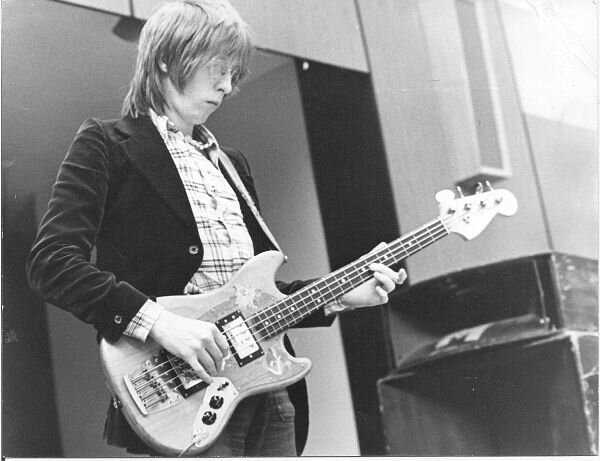
The Sutherland Brothers, Iain and Gavin, were prolific songwriters for Island Records, and had their songs covered by other artists, including Rod Stewart ("Sailing"). They used studio players on their records, including members of Quiver. At the proffer of the Brothers' director, the bands joined forces, and quickly went into the Island Records studio where Muff Winwood produced their unmarried, "You Got Me Anyway," which was a hit in the UK and U.S. The ring, now known as The Sutherland Brothers and Quiver ("SB&Q"), supported Elton John at the onset of his popularity in the early 70s.
Suddenly, the band was playing big, prestigious venues including Madison Square Garden, the Hollywood Bowl, and football stadiums. I of the early shows on the bout involved an additional band on the neb, Steely Dan. Bruce was a fan of the band and its debut LP Tin can't Purchase A Thrill – admiring their stellar songwriting, musicianship, arranging, and production. Bruce's yen for Steely Dan well-nigh killed his chance to be an Attraction…
Following his tenure in SB&Q, Bruce was hoping to hook up with Wilko Johnson, who had recently left Dr. Feelgood. That gig didn't pan out, and then Bruce, feeling something new was percolating in the music scene, kept his eye on the "Musicians Wanted" column of Melody Maker. One day he saw an ad seeking a bass thespian and keyboard role player for a "rocking popular combo." He had recently read an article well-nigh a performer who was existence touted as the side by side large thing and was in search of a backing ring: Elvis Costello. Bruce's intuition led him to retrieve this advert related to Elvis Costello.
Bruce dialed the number, connecting with the office of Elvis' label, Stiff Records and asked the receptionist virtually the artist who placed the advertisement. Her response was "he's like Buddy Holly on acid!" Bruce immediately heard a voice in the background, later confirmed to be Elvis, shouting, "ask him who he likes!" Suzanne the receptionist did as she was instructed.
"What bands exercise you similar?"
"The Rumour and Steely Dan…"
"Get rid of him!" the male voice shot back!
"No, I recall yous should give him a chance!"
Suzanne gave Bruce the details for the audition. And not long after, she became…. Mrs. Bruce Thomas.
Bruce purchased the records, learned the bass parts, and nailed the gig with the help of the drummer – Quiver'southward biggest fan, Pete Thomas. According to legend, manager Jake Riviera was checking Bruce out, and Pete told Elvis and Jake, something to the effect that "if you don't become this guy, you must be mad," and that probable sealed the deal.
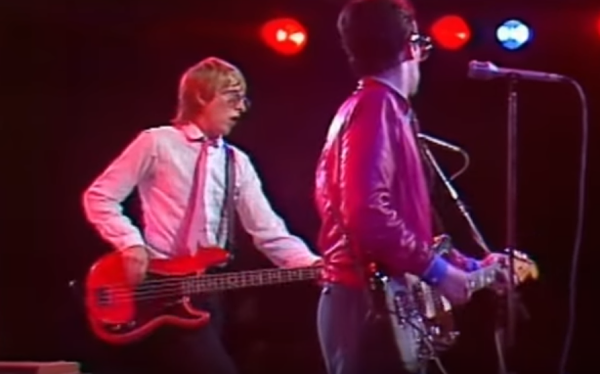
Among the near pop songs in The Attractions repertoire and a striking record on FM radio in America, "(I Don't Desire to Go to) Chelsea" is notable for Bruce's prominent bassline, which was a spikier version of the riff John Entwistle played at the end of the alive version of "My Generation." Bruce'south basslines not simply drove many of the songs, but he advocated for the proper noun The Attractions because it was similar to Motown's Temptations. And it stuck.
Bruce was a member of the Attractions from 1977-1988, and from 1994-1996, recording several albums, singles, and EPs, and touring the globe endlessly. His favorite records include This Year's Model, Get Happy (twenty songs bursting with energy and melody, most under two minutes, many washed in one take, and with few overdubs) and the baroque pop archetype Purple Bedroom.
All of Elvis' albums with The Attractions are a showcase for Bruce's stunning basslines. One that always jumps out at me (and scores of bassists) is "Lipstick Vogue" from the very first Attractions long-actor This Yr's Model. Bruce has no idea where that hyperactive skittering bass function came from; he simply started doing information technology. He has, however, explained the origins of some of the other songs. "The bass on 'The Beat' is similar Paul McCartney'south on 'Taxman,' with additional flourishes you might hear on a guitar. 'You Belong To Me' is a reworking of a Solomon Shush riff."
The title track "This Year's Girl" is a hybrid of the Stones' "Stupid Girl" and The Beatles' "You Won't See Me." The bass line on "Pump It Up" was a combination of multiple songs. Rhythmically information technology was the same as "The Price of Dearest" by the Everly Brothers, the notes came from Richard Hell and the Voidoids' "You've Got to Lose." And he even filled the last space with the riff from the Kinks' "You Really Got Me."

In some other twist, the bass on the chorus of "Pump It Upwardly," quotes "In The Mood," as a tribute to Elvis' dad, Ross McManus, whose band, Joe Loss and his Orchestra, used the song as its signature melody.
As per Bass Player magazine's clarification of Bruce'south playing on Model, "Bruce rules the sonic landscape with killer tone, wicked articulation and inventive lines that seem to bound out of the mix and whack y'all across the face…it's a must for any rock bassist seeking some inspiration." Bruce's parts on "Pump Information technology Up," "Chelsea," and a number of other songs were played live in the studio, in one take!
A turning signal for the ring (and the history of rock and roll) was their legendary advent on Saturday Night Alive in December 1977. Overnight they went from a band for people in the know, to a band everyone knew. Before they striking the stage, Bruce and John Belushi duetted on a Willie Mabon song in the dressing room. Turns out Bruce'south rhythm and dejection days served him well that night, as Belushi was request if whatever of the band members were into the dejection. It was a big nighttime for Bruce and the band from kickoff to end.
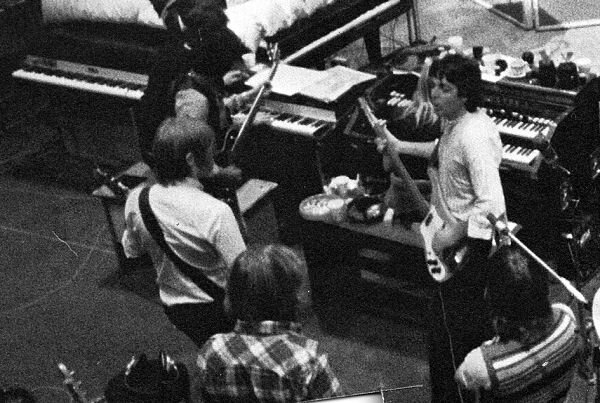
While recording the Armed Forces anthology in 1979, Bruce received an unexpected call in the studio asking whether he wanted to do a recording session with Paul McCartney, as if anyone could or would pass up an invite from Paul! When Bruce arrived at Abbey Road Studio 2, he found a "rock orchestra." At that place were 3 of every instrument, all playing live in the studio akin to legendary producer Phil Spector's "Wall of Sound."
The two other bass players were John Paul Jones of Led Zeppelin and Ronnie Lane of the Faces. When Bruce told Paul he had taken a few of his motifs over the years, to Bruce's surprise, Paul picked up a bass, and played a few licks from "Chelsea."
The "Rockestra Theme" that was recorded that day won a Grammy for All-time Instrumental Operation in 1980, and Bruce got to reprise his recordings with Sir Paul, as well as some Footling Richard songs, when both Elvis and The Attractions and Sir Paul were on the beak for the benefit for Kampuchea which took identify at the Hammersmith Odeon.
"Rockestra" https://youtu.be/zeeTlfbsKL8
Bruce's second brush with a Beatle involved John Lennon and Yoko Ono. Mrs. Lennon was assembling an album of her songs as a memorial to John, and Elvis and the Attractions contributed a New Orleans and Meters-inspired version of "Walking On Thin Ice," a track produced by Allen Toussaint.
Thomas feels that Purple Bedroom (1982) marked a watershed moment in his playing. On "Shabby Doll," he plied the riff with the added-9th harmony that a jazz bassist had shown him years earlier. On "Human Easily," he rendered a verse using bass chords, and on "The Loved Ones," he came up with a walking bass line that could walk alongside Paul's bright passage on "All My Loving."
Though there were breaks in the action, Elvis and The Attractions had a stellar career in the studio, and on phase, and information technology culminated with their 2003 induction into the Stone and Roll Hall of Fame.
Exterior of his tenure in The Attractions, Bruce did plento of studio work, including a session with the notoriously moody Chrissie Hynde. The project included a new group of players, every bit the founding Pretenders bassist and guitarist had passed, and the original drummer Martin Chambers didn't play on the record. Bruce appeared on only one rails, "My Baby," due to creative differences every bit to the arroyo i.due east. functional playing versus creative playing. Admonished Ms. Hynde "in The Pretenders we don't go above the 5th fret!"
Among Bruce'south more pleasant experiences was recording with John Wesley Harding – with Pete Thomas, including a killer version of Tommy James' classic "Crystal Blueish Persuasion." Bruce recorded with Al Stewart, Madness, Billy Bragg, and Tasmin Archer, amongst many others. Bruce was particularly impressed with Suzanne Vega, helming the bass chair for her album 99.9 F. Bruce used a Danelectro Longhorn on the Vega recordings, as well as on many of his other studio sessions.
Bruce likewise collaborated with his nephew – writing and producing trip the light fantastic and "chill-out" music under diverse names. That music was pressed onto 12-inch records and was popular with DJs spinning music in the dance clubs dorsum in the days when vinyl was the preferred medium.
In 2022 Bruce recorded a ten-rail collaborative album with vocaliser-songwriter Spencer Brown entitled Dorsum To The Start. The partnership started informally when Spencer asked Bruce to heed to a few songs he was working on…and Bruce came on board to play and adapt the record.
Manner: I of the offset bass parts Bruce learned was Booker T & The MG's classic "Dark-green Onions." Though it was an easy three-note riff (rendered by original MG's bassist Lewie Steinberg, and not Duck Dunn, whom information technology is often attributed to) more chiefly, it taught him how to play a groove. In terms of his active bass lines, Bruce attributes that influence to Jack Bruce and the Fresh Foam LP, likewise as to McCartney and Entwistle, along with Us players such as Jamerson, Phil Lesh, and Jack Casady. In the Attractions, he had the ability to play the agile bass lines he created, in part, because Elvis told the ring early on that there would be no guitar solos in his band, so it gave Bruce space to play creatively.
Approach: In terms of Bruce's approach, timing is his priority, and melodically distinctive notes come up in 2d. Tone is also essential to Thomas – he stresses that the tone of a bass guitar emanates from the role player. That is, where you striking the strings, how near to the bridge, tension and relaxation, how you release the notation — and many other factors!
Elvis and The Attractions mostly played alive on backing tracks when recording their LPs. However, Bruce altered his work method in the studio with other artists. On occasion he would return a guide part to help the musicians while the bones track was recorded, and so cut his final runway when the overdubs and song parts were done. When putting the main bass part on, he would non concentrate on binding the chords to the rhythm. Instead, he would try to tie the vocal to the drums, taking harmonic cues from the vocal melody and inflections, and bring the vocalism and drums together.
At the height of The Attractions popularity, Bruce was famous for his "salmon pinkish" Fender Precision bass, strung with Rotosound Round Wounds guess 55-115 (nowadays he uses Base Centre Elites with a more conventional 45-105). Back then a P bass price a fortune in the UK – almost a year's salary for working class players. Bruce's purchased a used Precision, and stripped it dorsum to the woods grain, and added a tortoise shell scratch plate. When he attempted to replicate Jet Harris' instrument, faded fiesta red, the color turned a shade of pink. He would sometimes add a wad of foam by the bridge to have better articulation of the notes.
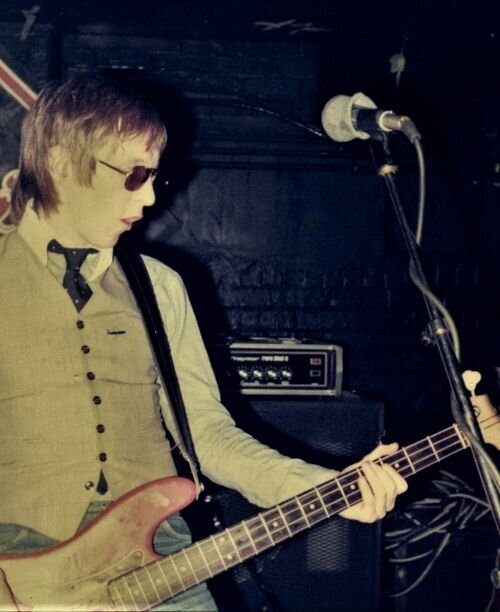
Unfortunately, Bruce's pink P was stolen from his car while he was in Los Angeles working sessions. Though he tried to detect a suitable replacement, information technology wasn't simply a matter of replacing an early 1960s P-bass, every bit he had made many modifications to it. Bruce had reshaped the body and the neck, rewired it and re-sprayed it. As a result, after much searching with no luck, he ended that he would take to reproduce it from scratch.
When Bruce informed Barry Moorhouse of the Bass Centre in London of his mission to replicate his signature instrument Barry felt that other players would be interested in having a like bass, hence the cosmos of the BT signature model bass as part of their new British Bass Masters series.
http://world wide web.basscentre.com/british-bass-masters/bruce-thomas-contour.html
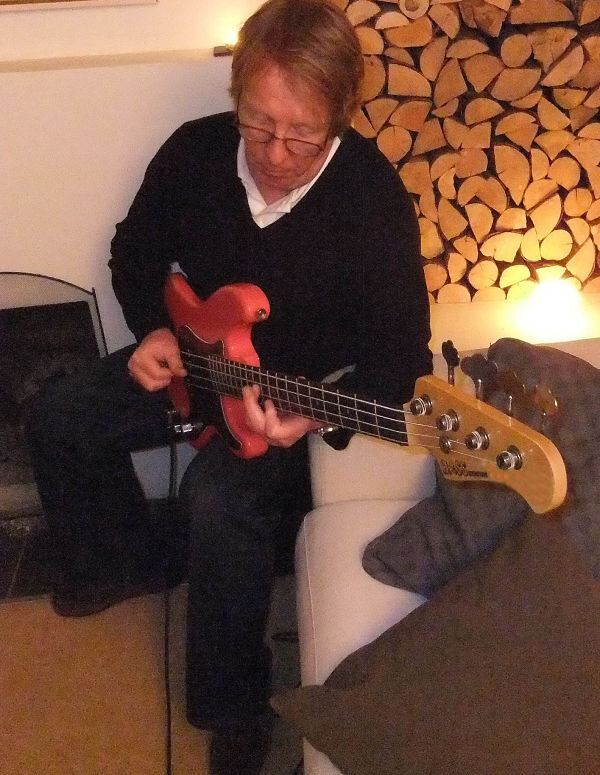
Courtesy of Bass Middle
Bruce is too partial to Danelectro basses, which he used during the 1990s on phase and in the studio with The Attractions, and in the studio with other artists. He likes the Danelectro Longhorn Rumor with the built-in Chorus, and Hodad basses. Over the years, Bruce has used multiple basses, including a Gibson EB-0, Fender Mustang, Fender 6-string, Hagstrom 8-string, Hamer viii-string, and Hamer 12-string.
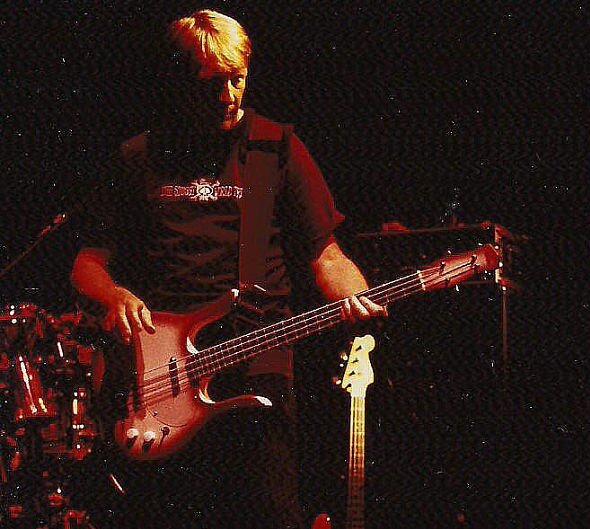
His bass rigs take gone from a Traynor Mono Block with two cabs each containing ii x 12s and a 1×18, to two Ampeg SVTs, to two early Trace Elliot heads with 4 4×x cabinets stacked side-by-side.
For a deeper swoop into his life and music career, cheque out Crude Notes…and Grainy Images, published in 2017, which is both an autobiography and cultural history, covering his entire career in music.
His website https://www.brucethomas.co.britain/ is likewise a wealth of information.
Select Bruce Thomas tracks with The Attractions!
Elvis and the Attractions-Live-Théâtre de fifty'Empire à Paris (1979) https://youtu.exist/rzsWpYQ2mIs
"Lipstick Vogue" https://youtu.be/QN0ntOO5gVc
(I Don't Want to Go To) Chelsea-Live at Rockpalast https://youtu.exist/ITx5vzQi0go
"Oliver's Regular army" https://youtu.be/LrjHz5hrupA
"Everyday I Write the Book" https://youtu.be/V1d4r9awjKE
"Pump Information technology Upward" https://youtu.exist/3Y71iDvCYXA
("What'due south And so Funny 'Bout) Peace Love and Agreement https://youtu.be/Ssd3U_zicAI
With Suzanne Vega:
"99.9F" https://youtu.be/uEvjFThqmq0
With Spencer Brown:
"Back to the Start" https://youtu.be/QYM1EIztn4I
"Thursday" https://youtu.be/_XLMbZE_ZvA
"Fall On You lot" https://youtu.be/nUWj_OiGf1s
taylorfroustommer.blogspot.com
Source: https://knowyourbassplayer.com/tag/elvis-costello-and-the-attractions/
0 Response to "Imperial Bedroom Lyrics Chords Best Again Dressed"
Post a Comment